
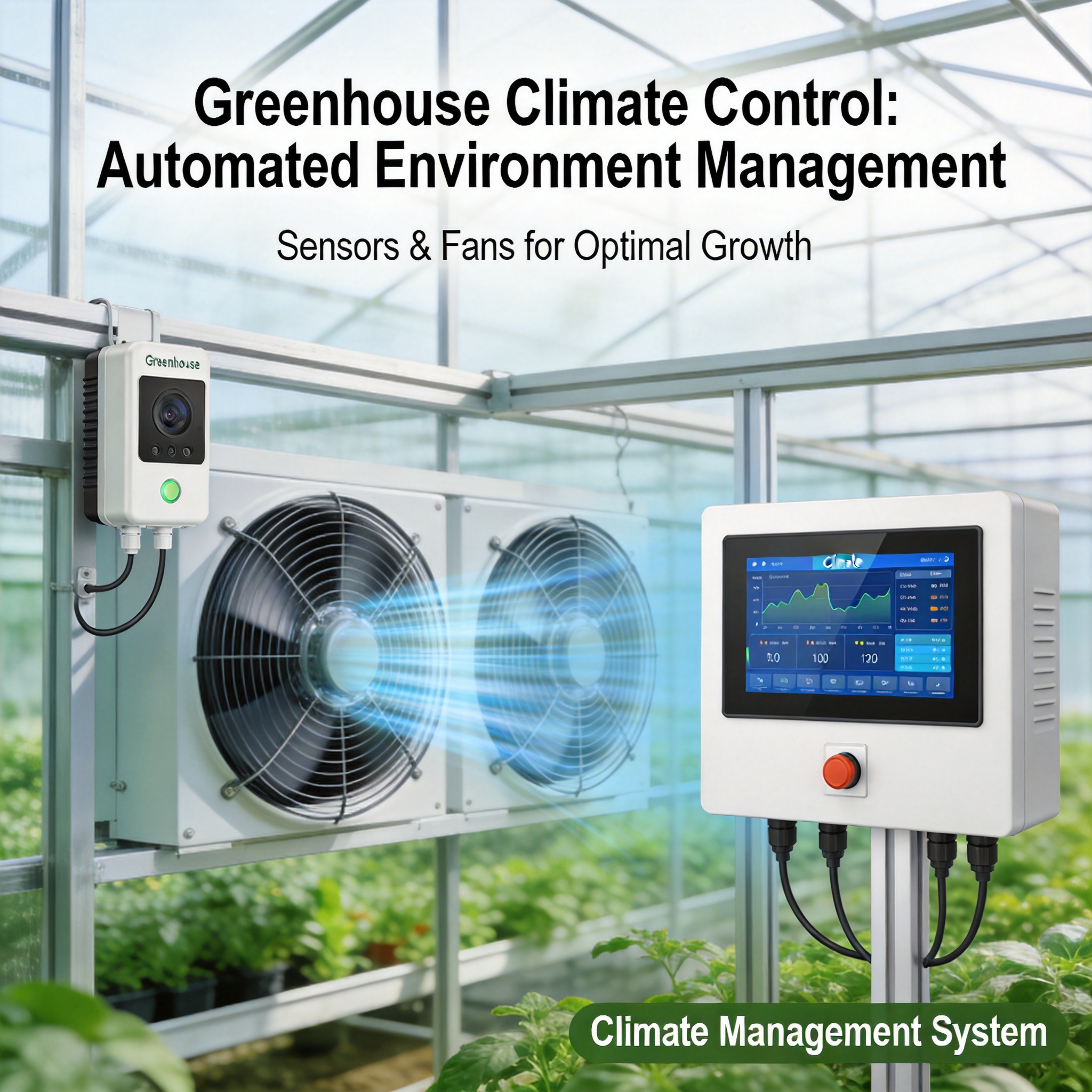
A practical approach to greenhouse temperature, humidity, ventilation and shading, with attention to crop observation, commissioning and daily operating decisions.
A greenhouse climate strategy begins with the crop, rather than a list of machines. Heating, ventilation, shading, circulation and irrigation all change the environment around the plants, and their effects overlap. A controller can execute instructions consistently, but the grower still needs to decide what conditions the crop requires and whether the installed equipment can deliver them. The useful question is therefore how the whole greenhouse behaves through a working day, including cloudy mornings, strong afternoon radiation and the transition into night.
Define conditions for the actual production plan
There is no single temperature or humidity setting suitable for every greenhouse. Crop species, variety, growth stage, planting density and production objectives all influence the target. Begin with an agronomic plan and describe acceptable day and night conditions, seasonal adjustments and the circumstances that require intervention. Separate an operating target from an emergency alarm. This gives the grower and equipment supplier a shared basis for discussion, while leaving room to revise the strategy as observations from the crop become available.
Measure where the plants are growing
A reading from the equipment room cannot describe conditions throughout the canopy. Position protected sensors in representative growing areas and review their location as plant height changes. Direct sunlight, a heater outlet or a cooling pad can distort a poorly placed measurement. Compare different parts of the greenhouse before assuming that one reading represents the entire house. Keep sensors clean, check them against a suitable reference and record calibration work. Reliable control depends on both the instrument and the place where it measures.
Coordinate ventilation, shading and cooling
Opening a vent, closing a shade screen and starting evaporative cooling affect more than air temperature. They also change light, moisture and the exchange of air with outside conditions. Evaporative cooling performance depends on the outdoor climate; adding moisture is less effective when the incoming air is already humid. Review equipment capacity together with local weather and crop requirements. Specify the order in which actions occur, how long the controller waits before changing stage, and which weather conditions restrict vent or screen movement.
Treat humidity as part of crop management
Relative humidity changes with temperature, so the same percentage can describe different conditions at different times. Vapour pressure deficit can add useful context, but its interpretation still depends on the crop and on whether air or leaf temperature is being considered. Watch for condensation on leaves and structural surfaces, especially around evening and early morning transitions. Circulation can improve air movement within the house, while ventilation exchanges air with outside. Neither should be assumed to solve every moisture problem without checking the actual conditions.
Connect irrigation decisions to the climate
Water delivered to roots eventually interacts with canopy growth and greenhouse moisture. A fixed irrigation programme may become inappropriate when radiation falls, crop size changes or screens alter the environment. Compare irrigation records with root condition, substrate moisture and the daily climate pattern before making adjustments. Avoid using extra water as a general response to wilting without investigating the cause. Climate and irrigation teams should share observations so that one system is not being adjusted to compensate for a problem created by the other.
Commission the sequence, not just each device
A fan that starts and a vent that opens do not prove that the greenhouse is ready for production. Test how heating, cooling, screens and ventilation interact, including transitions between operating stages. Confirm sensor readings, movement limits and alarm delivery. Simulate faults only through safe procedures agreed with the installer, and document the expected response to a failed sensor or interrupted power supply. Staff need access to manual controls and a clear escalation route when automatic operation cannot maintain the agreed conditions.
Review results through the crop cycle
Look at trends alongside observations of plant growth, flowering, fruit set and disease pressure. A daily average can hide a short period of excessive heat or a long night of condensation. Record significant setting changes and compare the response before making another adjustment. Include energy use, maintenance and staff time in the review, rather than judging success only by a smooth screen display. The aim is a repeatable environment that supports saleable production within the farm's practical operating limits.
For a climate-control discussion with AGRINOVIX, bring the crop plan, site weather information, greenhouse dimensions and available utilities. Ask how the proposed systems work together, how performance will be checked and who will support the installation locally. Good climate control combines suitable engineering with disciplined observation. Its value becomes visible when growers can explain both what the equipment is doing and why that action is appropriate for the crop.