
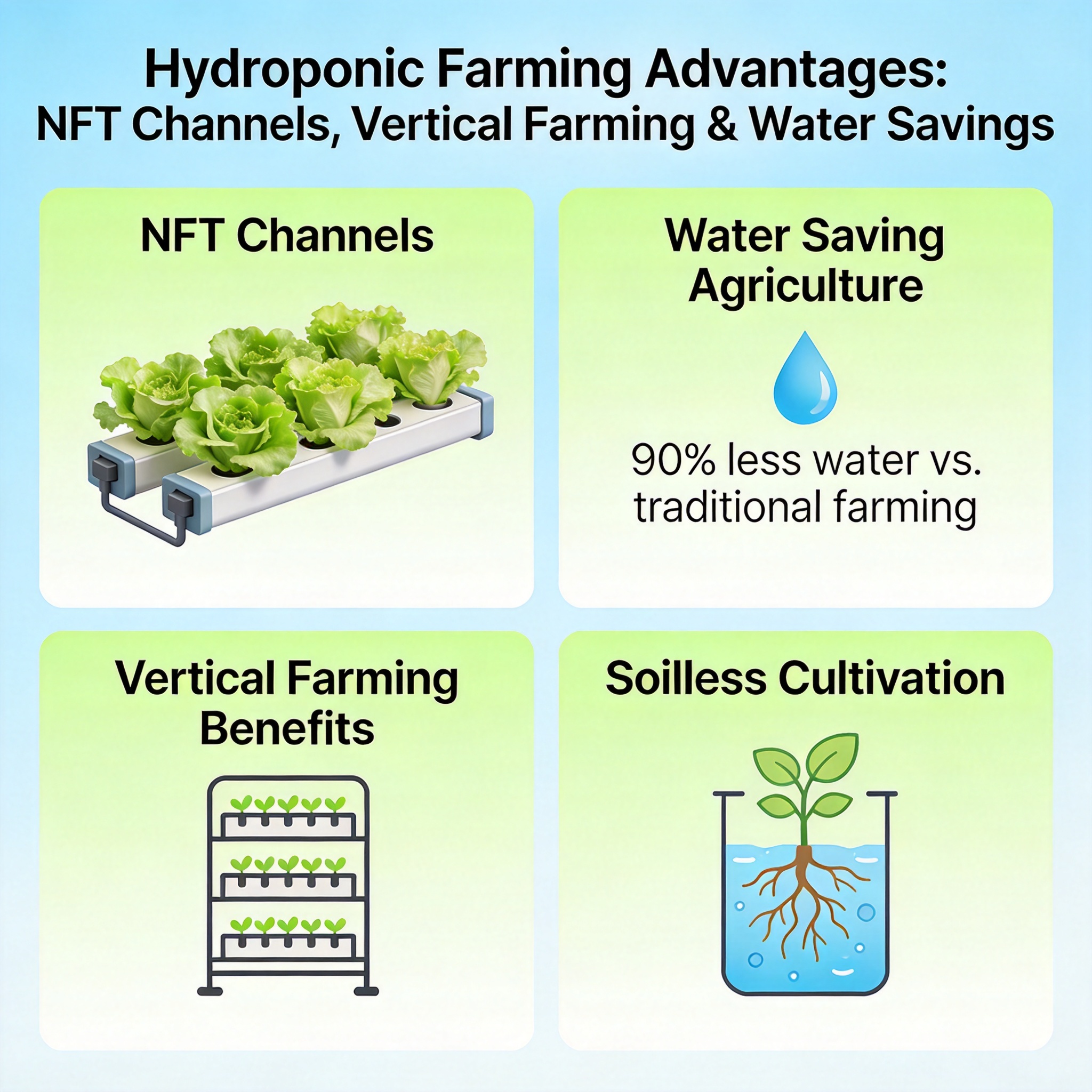
Assess hydroponics through root-zone management, water reuse, crop suitability, labour and operating resilience before making an investment decision.
Hydroponics offers a different way to manage the root environment, rather than a guarantee of higher profit. Plants receive nutrients through a prepared solution, with roots supported by the system or by a suitable growing medium. This can create valuable opportunities where soil conditions, water availability or production consistency are limiting. However, the advantages depend on the crop, the installation and the people running it. A useful investment discussion asks which existing constraint the system will remove and what new responsibilities the farm will accept.
Reduce dependence on the existing soil
A soilless arrangement separates much of root-zone management from the native soil. This can be useful where soil characteristics or production history make conventional cropping difficult. It does not remove the need to evaluate the site. Foundations, drainage, flood exposure, access and utilities still affect whether the project is workable. Nor does removing soil eliminate all diseases or hygiene requirements. The practical advantage is a more deliberately designed root environment, supported by a plan for handling plants, water and equipment throughout the crop cycle.
Make water reuse a designed process
A recirculating installation can collect and reuse solution that would otherwise leave the production system. The opportunity is significant where water is constrained, but actual savings depend on the comparison and operating conditions. Evaporation, crop uptake, cleaning and any necessary discharge still contribute to water use. Specify collection, storage, treatment and monitoring together. A return line alone does not establish safe or effective reuse. Water quality and changes in solution composition must remain part of the management plan after the equipment is installed.
Gain visibility into nutrition
Prepared nutrient solutions allow the farm to adjust inputs without depending entirely on nutrient release from soil. That makes measurement and record keeping especially useful. Electrical conductivity and pH help monitor operation, but neither identifies the concentration of every nutrient. Source water, crop uptake and replenishment influence the solution over time. Build an appropriate sampling and review routine rather than treating one recipe as permanent. Better control means the ability to investigate and respond, not an assumption that every plant is receiving an ideal balance automatically.
Choose a layout that suits the crop
Hydroponics describes a family of arrangements, not one interchangeable product. Shallow-flow channels, deep-water systems and substrate-based drip production place different demands on support, oxygen, irrigation and access. Compare the mature crop, root volume and harvesting method with the proposed layout. A dense planting drawing does not prove that workers can inspect or harvest the finished plants efficiently. Use a representative trial where uncertainty is high. The relevant advantage is productive use of the available area while preserving crop quality and manageable daily work.
Improve consistency through repeatable routines
Defined containers, delivery paths and monitoring points can make production easier to compare between areas and cycles. The benefit appears when staff follow consistent procedures for propagation, planting, irrigation, inspection and cleaning. Equipment alone cannot guarantee uniform crops. Differences in light, temperature, plant material and maintenance still matter. Record both the settings and the plant response, and investigate variation instead of averaging it away. A more measurable system is valuable when the team uses those measurements to improve decisions over successive production cycles.
Account for dependence on equipment and people
Removing soil can increase reliance on pumps, aeration, dosing or continuous monitoring, depending on the design. Examine power loss, blocked delivery, low solution level and instrument error separately. Different systems provide different operating buffers, and none should be described as risk free. Plan alarms, spare parts, manual checks and local support around the actual installation. Include staff training and cleaning time in the cost comparison. Operational discipline is part of the investment because the system's advantages depend on maintaining suitable root conditions reliably.
Compare commercial outcomes, not headline yields
Evaluate marketable output, quality, labour, water, energy, inputs and downtime together. Compare equivalent crops and seasons wherever possible, and state the assumptions behind any estimate. Higher planting capacity does not necessarily produce higher sales if grading losses or market access become constraints. Include commissioning, learning time and realistic maintenance in the financial plan. A pilot should answer specific questions about production and management. Evidence from the farm's own operating conditions is more useful than a percentage presented without a clear baseline.
When discussing hydroponics with AGRINOVIX, explain the crop, the existing production constraint, source-water conditions and the skills available locally. Ask how the proposed system addresses that constraint and what routine work it introduces. Hydroponics can make water and root-zone management more deliberate and measurable. Its strongest commercial case is a well-matched system that the team can operate consistently, supported by a market that values the resulting produce.